.avif)
National Security & Trade Compliance
Sanctions, Export Controls, and Customs regulations today sit at the forefront of U.S. foreign policy, leveraging the country’s economy in a manner having ripple effects on manufacturers, resellers, distributors, logistics providers, and financial institutions.
Akrivis has long been a prominent and established name in this area, serving as a “go-to” firm for clients around the world seeking high level expertise on compliance and enforcement issues.
Akrivis handles a broad range of complex and sensitive matters for clients whose international business activities involve the movement of goods and services across borders, and whose trade and investment activities may be controlled for national security, foreign policy, anti-terrorism, crime control, or non-proliferation reasons. These issues arise in the context of government inquiries and investigations, settlements of enforcement actions, audit committee and internal investigations, corporate due diligence, and complex cross-border transactions.
Akrivis regularly counsels on a host of regulatory laws that affect their international business, including sanctions, export controls, customs regulations, and foreign investment in the United States. We routinely represent before the U.S. Department of the Treasury’s Office of Foreign Assets Control (OFAC), the U.S. Department of Commerce’s Bureau of Industry and Security (BIS), the U.S. Department of Homeland Security’s Customs & Border Protection (CBP).
More Detail
U.S. trade policy is increasingly at the forefront of national security, with its impact felt far beyond the borders of the United States. These policies leverage the U.S. economy and have pronounced ripple effects on not only manufacturers, resellers, distributors, logistics providers, but also financial institutions and other sectors. Akrivis has long been a prominent and established name in this area, serving as a “go-to” firm for clients around the world seeking high level expertise on compliance advisory and enforcement. We handle a broad range of complex and sensitive matters for clients whose international business activities involve the movement of goods and services across borders, and whose trade and investment activities may be controlled for national security, foreign policy, anti-terrorism, crime control, or non-proliferation reasons. These issues can arise in the context of licensing, government inquiries and investigations, settlements of enforcement actions, audit committee and internal investigations, corporate due diligence, and complex cross-border transactions.
Our clients benefit from our subject matter expertise, deep knowledge on critical regions of the world that are on the frontlines of U.S. national security-driven trade policy, and our fluency in key languages such as Russian, Persian (Farsi), and Spanish, among others.
Sanctions & Export Controls
Akrivis has a broad-based sanctions and export controls practice, advising companies around the world on regulations administered by the U.S. Department of the Treasury’s Office of Foreign Assets Control (OFAC) and the U.S. Department of Commerce’s Bureau of Industry & Security (BIS). This includes general advice, licensing, developing compliance policies, delistings, and other civil as well as criminal enforcement. Our clients in this space have included major multinational financial institutions, as well as manufacturers, global technology companies, family offices and companies in sectors such as hospitality, engineering, resellers, and sovereign investment.
Customs
The role of customs has continually expanded in recent years as a tool of U.S. trade and security policy. We have represented companies navigating the ever evolving tariff rules of the United States, as well as sanctions administered by the U.S. Department of Homeland Security (DHS) Customs & Border Protection (CBP), such as in the context of a Withhold Release Order (WRO). This work also overlaps with other regulatory areas such as transportation and food and drug regulation, on which we have also advised clients.
Committee for Foreign Investment in the United States (CFIUS) and Outbound Investment
Both inbound and outbound investment represent a key part of the ever-evolving national security legal framework in the United States. The Committee on Foreign Investment in the United States (CFIUS) continues to expand its jurisdiction and role in regulating inbound investment in sectors of the U.S. economy critical to national security, and OFAC now regulates outbound investment in certain sensitive technologies involving countries of concern. Akrivis has been advising clients on both categories of activity.
Foreign Corrupt Practices Act (FCPA)
Dovetailing our trade security policy is our FCPA practice. We have represented U.S. and foreign clients in federal investigations of alleged FCPA violations, advised parties on complying with the FCPA, including helping integrate proper internal procedures.
Representative Matters
Examples of our work include:
- Securing the removal of two Russian ex-bankers from OFAC’s List of Specially Designated Nationals and Blocked Persons (the SDN List)
- Successfully representing clients in responding to OFAC Administrative Subpoenas
- Securing the removal of multiple companies from the BIS Entity List and a removal from the Unverified List (UVL)
- Applying for licenses from OFAC and the BIS for a host of activities, such as transactions involving Iran, Afghanistan, Venezuela, Cuba, and Russia
- Representing clients before CBP on the Xinjiang Uyghur Autonomous Region (XUAR) Withhold Release Order on cotton and tomato products, securing the release of detained goods
- Devising robust compliance policies for businesses in the United States and abroad to comply with U.S. policy with key risk abating approaches
- Assisting companies having difficulty in foreign wire transfers due to ongoing federal investigations or simply outdated information in screening databases

Washington, D.C. — Akrivis Law Group, PLLC is pleased to announce that Nicholas (Nick) Turner, a globally recognized lawyer in the field of sanctions, anti-money laundering (AML), and export controls, has joined the firm as Partner in its Washingtons, D.C. office.
Now based primarily in the United States, Nick joins Akrivis from the Hong Kong operations of leading global digital asset exchange Binance, where he most recently served as Global Sanctions Lead Counsel. His addition strengthens Akrivis’s already robust sanctions, AML, export controls, anti-bribery, and white-collar defense capabilities, bringing over a decade of experience advising leading international financial institutions and multinationals in one of the world’s top financial hubs.
Nick has advised clients throughout Asia, the Americas, Australia, Europe, and the Middle East in the financial services, digital assets, telecommunications, logistics, e-commerce, aviation, and other sectors. He helps companies understand when and how regulations apply to their business, how to respond when regulators come calling, and how to approach transactions to mitigate risks from regulations, counterparty requirements, and geopolitics.
Nick’s experience also includes acting as in-house counsel for a UK-headquartered financial institution and as external counsel in the Hong Kong offices of major U.S.- and U.K.-based law firms. He has advised clients throughout Asia, Australia, Europe, the Middle East, and the Americas in the financial services, digital assets, telecommunications, logistics, e-commerce, aviation, and other sectors. Nick’s work spans compliance, regulatory enforcement, investigations, and transactional support across multiple jurisdictions and regulatory regimes. In recent years, he has extensively advised on key issues related to U.S.-China tensions, multilateral sanctions against Russia, and the evolving Middle East landscape.
“Akrivis was my first choice,” Nick said. “The firm has built a reputation for advising clients on exactly the kind of complex, cross-border matters I've spent my career working on. What drew me here is the opportunity to give companies straightforward advice in plain language — informed by first-hand experience of how these rules actually land on businesses operating outside the United States."
“Whether a client is interpreting a new regulation, deciding how to approach a transaction, or build a compliance program, I am ready to help,” Nick said.
“Nick brings a very unique perspective that very few U.S. lawyers offer in this space,” said Farhad Alavi, Akrivis Managing Partner. “This is a logical and strategic step in Akrivis’s expansion trajectory, aligned with our recent ascent in our core practices, and will boost our already robust representation of clients around the globe. His diverse experience, including years of practice in Hong Kong, gives him a perspective on the logistics of international sanctions, and money and technology flows involving China that very few people in this sector can match. This translates to advice clients can readily use."
In addition to his legal practice, Nick co-developed and taught a course on Sanctions Law and Practice at the University of Hong Kong, in which students explored how complex sanctions laws and regulations apply to corporate actors. He has authored several book chapters on corporate decision-making about sanctions and served as co-editor of the Global Investigations Review (GIR) Practitioners' Guide to Sanctions. He was recognized as a Global Investigations Review 40 Under 40 investigations specialist and is a Certified Anti-Money Laundering Specialist (CAMS).
Nick is admitted to practice in the State of New York. He divides his time between North America and Hong Kong. Nick can be reached at nturner@akrivislaw.com.



June 23, 2026
Key Takeaways:
- Joint Enforcement: The U.S. Department of Justice (“DOJ”) National Security Division ("NSD") and U.S. Department of Commerce’s Bureau of Industry & Security (“BIS”) on June 17 announced significant penalties against Robert Bosch GmbH (“Bosch”) for alleged violations of U.S. export control prohibitions against China’s Huawei Technologies Co., Ltd. and related affiliates (collectively, “Huawei”).
- These violations resulted from a misreading of the scope of the Foreign Direct Product Rule (the “FDP Rule”) by company personnel, leading the company to incorrectly conclude that its non-U.S.-produced items were not subject to the jurisdiction of the Export Administration Regulations (“EAR”).
- This enforcement action involves severe penalties - $36 million in BIS penalties and an $11.4 million disgorgement of profits by the DOJ, $7.8 million of which was credited towards the BIS penalty. Bosch, a $90 billion company, has hired 66 additional compliance officers as part of its mitigation efforts (throughout most of the period at issue, the company had two employees in the U.S. serving in the compliance function).
- These violations resulted from a misreading of the scope of the Foreign Direct Product Rule (the “FDP Rule”) by company personnel, leading the company to incorrectly conclude that its non-U.S.-produced items were not subject to the jurisdiction of the Export Administration Regulations (“EAR”).
- First Declination of an NSD matter under the DOJ’s Corporate Enforcement and Voluntary Self-Disclosure Policy (“CEP”): DOJ made clear that Bosch received this declination after voluntarily self-disclosing the misconduct, fully cooperating with the government’s investigation, timely and appropriately remediating the root causes of the violations, and in the absence of aggravating factors, making it a first of its kind case under the CEP.
- The Case for Refined Compliance Management: Expanding compliance as a mitigation and risk prevention strategy for future violations is commonplace. Despite being a $90 billion company with offices in over 60 countries, compliance was poorly managed. In addition to the dearth of adequate resources, management had failed to ensure consistent compliance across the group’s international operations. Spotty compliance can dramatically elevate the likelihood of compliance breaches even in the largest, most sophisticated companies with comprehensive policies.
Background:
An international technology and services company headquartered in Germany, Bosch produces sensors and software that were provided to Huawei, which was placed on the BIS Entity List in 2019. The items in question were produced outside of the U.S. but determined by BIS to be subject to the export control restrictions under the EAR. This was based on the timeline below:
.png)
Compliance Takeaways:
- The Bosch Declination could signal the NSD’s increased use of the CEP and reliance on the DOJ Principles of Federal Prosecution of Business Organizations
The Bosch declination may provide insight into how DOJ intends to apply both its new Department-wide CEP and the Principles of Federal Prosecution of Business Organizations in export controls and national security matters. The Department-wide CEP announced in March 2026 largely builds upon the Criminal Division's longstanding Corporate Enforcement Policy, which originated in the FCPA arena and rewards companies that voluntarily self-disclose misconduct, fully cooperate, and timely remediate compliance deficiencies.1 Bosch, as the first NSD declination under the same policy, suggests DOJ is applying a consistent enforcement approach across traditionally separate enforcement areas. As a result, companies confronting potential export controls violations may increasingly evaluate disclosure decisions through a framework familiar to FCPA practitioners: absent significant aggravating factors, prompt self-disclosure, robust cooperation, and meaningful remediation may substantially reduce the risk of criminal prosecution. In Bosch’s declination letter, the NSD highlighted several remediation efforts taken by the company, demonstrating the substantial development of Bosch’s trade compliance policies. Following the investigation, the company hired 66 employees to its trade compliance team, broadly expanded U.S. trade compliance resources, and updated its internal policies to clarify when U.S. export control jurisdiction and licensing requirements apply to the business’s activities.
According to the DOJ, these efforts, along with Bosch's voluntary self-disclosure and extensive cooperation throughout the investigation, weighed heavily in favor of a declination rather than criminal prosecution.2 As such, the matter may serve as an early roadmap for companies evaluating whether to voluntarily disclose potential export controls violations to DOJ, and what steps can be taken after the fact to mitigate the risk of prosecution. As U.S. export controls and broader economic policy continue adapting to meet evolving national security priorities, DOJ’s CEP encourages prompt disclosure, cooperation, and remediation efforts through sophisticated corporate compliance protocols and mechanisms.
- Businesses worldwide should develop a sophisticated understanding of FDP Rules
Importantly, the EAR’s jurisdiction can extend far beyond shipments originating from or transiting through the U.S., as can be seen in the FDP Rules. The Huawei FDP Rule covers Huawei and its non-U.S. affiliates (so-called “Footnote 1 entities”). In the Bosch case, the compliance team’s confusion in the product scope provisions of the August 2020 FDP Rule helped cause continuous violations.
Broadly, the FDP Rules3 extend U.S. jurisdiction to foreign-made products that are direct products of certain export-controlled technology or software that is subject to U.S. jurisdiction or made on equipment that is itself a direct product of such technology or software. These rules continue to evolve in accordance with foreign policy objectives and strategies that companies use to evade export controls.
- Distinguish De Minimis Rule and the FDP Rule: Content vs. Technology
Another key mistake Bosch’s compliance personnel made was conflating the de minimis rules, which was the long-established approach to determining whether a foreign-made product was subject to the EAR, with the FDP Rules, which substantially expanded the universe of foreign-made items subject to the EAR. One internal email erroneously determined that the products in question, Micro-ElectroMechanical Systems ("MEMS") sensor products and CycurHSM automotive firmware, were not subject to the EAR because the U.S.-origin content in each product fell below the de minimis threshold.
The De Minimis Rule calculates the value of U.S.-origin content as a percentage over the total value of the product and establishes a threshold below which the product generally is not subject to the EAR (25% for the purposes of exports to most destinations).4 The FDP Rules and in particular the Entity List FDP Rule implemented in August 2020 and with certain modifications dedicated specifically to Huawei (so-called “Footnote 1 designations”), expanded U.S. jurisdiction by focusing not on the percentage of U.S.-origin content, but on whether the foreign-made product is a direct product of certain export-controlled technology or software that is subject to U.S. jurisdiction, or made on equipment that is itself a direct product of such technology or software. In Bosch’s case, some of the MEMS sensors were manufactured using epitaxy machines that were the direct product of U.S.-origin technology or software as defined in paragraph (e)(1)(i)(B) of the FDP rule, and the microcontrollers used to test the CycurHSM software were likewise determined to be direct products under the same rule.
The Bosch enforcement underscores that compliance teams must assess both the de minimis and FDP Rules when evaluating EAR jurisdiction involving foreign-made products.
- Streamline organizational response to potential red flags or violations.
Bosch’s organizational response leading up to the violations highlights certain definitive lessons for businesses adapting their trade compliance practices to evolving regulatory landscapes and the complexity of their business practices.
- Prioritize staffing and coordination of trade compliance teams across regions.
Bosch’s case highlights a common phenomenon of confusion over the U.S. export controls regime even among compliance personnel in major multinationals, and the imbalances of compliance program implementation and staffing know-how seen across global operations, even at some of the most prominent companies Multinational companies face continual challenges in equipping trade compliance teams with sufficient resources to adequately address new and complex regulatory changes. Such resources should include sufficient staffing as well as access to advanced legal expertise to check the internal interpretation of complex rules such as the FDPRs. While the particulars of training and guidance at Bosch are unclear, as a general matter, many multinationals’ foreign operations effectively function as islands, without central, top-down compliance directives and training. This can result in erratic “lone wolf” activity, dramatically expanding exposure to violations.
- Integrate compliance teams into relevant decision-making processes.
Bosch’s violations resulted from information asymmetry between trade compliance professionals and executives from BST, a Bosch subsidiary. Had Bosch’s trade compliance team obtained information about the production equipment, suppliers, and end-users, they may have been able to properly complete the analysis for applicability of the FDP rule. Communication with trade compliance teams, including questionnaires, guidance, and warnings, should be given high regard in the decision making related to all stages of production and distribution of an item.
- Calibrate compliance processes to adequately respond to warnings and red flags.
BIS’s release identified multiple warnings from outside vendors and supply chain partners to BST that were not properly addressed. Compliance teams should have clear authority to respond to such warnings while keeping senior management informed. Management, by contrast, should maintain internal review and accountability mechanisms to prevent reliance on incorrect or outdated guidance, which in this case contributed to continued violations of the export control rules. Management should ensure consistent training and resources across divisions as needed.
- Promptly investigate any potential compliance issues, disclose any violations and cooperate with BIS and other regulatory agencies.
BIS expects proactive due diligence and internal investigatory protocols if and when a compliance concern arises. Bosch received significant credit from BIS and DOJ for eventually conducting a full investigation and submitting a VSD to the DOJ covering its violations.
- Prioritize staffing and coordination of trade compliance teams across regions.
While the penalties were steep, by voluntarily self-disclosing and taking bona fide, earnest steps to remediate, Bosch materially mitigated what could have been a much larger punishment. The case for companies operating in sensitive sectors maintaining export control compliance is clear and not novel. More importantly, however, this particular matter highlights the need for comprehensive compliance maintenance, namely:
- adequate resource allocation;
- accurate and thorough advice; and very importantly
- proper compliance management and consistency of internal implementation and communication.
In addition to typically having only two compliance employees tasked with providing U.S. export controls guidance to the entire global group, Bosch was also insufficiently advised and lacked proper mechanisms for implementing group-wide compliance. Beyond proper resource allocation, companies should strongly consider top-down and bottom-up compliance quality control and risk management policies adequately addressing new developments to avoid miscommunications and “compliance deserts” often found in cross-border operations within a group or conglomerate.
______________________________________________________________________
Special thanks to John Kallas and Kristen Xiao for their assistance in preparing this Legal Update.
This Legal Update is intended solely for informational purposes and should in no way be construed as legal advice, nor shall the information shared here result in or constitute the formation of an attorney-client relationship with anyone who reads it. If you have any questions or are unclear on any of the subject matters addressed or discussed in this Legal Update, please consult a licensed legal professional.
______________________________________________________________________
*Admitted in New York. Admission to the District of Columbia pending.
[1] U.S. Dep't of Justice, Department of Justice Releases First-Ever Corporate Enforcement and Voluntary Self-Disclosure Policy for All Criminal Cases (Mar. 20, 2026), https://www.justice.gov/opa/pr/department-justice-releases-first-ever-corporate-enforcement-policy-all-criminal-cases.
[2] Letter from the Department of Justice to Fenwick & West LLP (counsel to Robert Bosch GmbH), June 15, 2026, available at https://www.justice.gov/d9/2026-06/bosch_-_executed_declination.pdf (last accessed June 22, 2026).
[3] 15 C.F.R. § 734.9.
[4] 15 C.F.R. § 734.4(d).
Partner, Washington, D.C.
Key Takeaways:
- On June 10, 2026, the U.S. Department of the Treasury’s Office of Foreign Assets Control (OFAC), issued Venezuela-related General Licenses (GLs) 46C, 47A, 48B, 50B, 51B, 52A, and 54A.
- These amend existing GLs authorizing a broad range of activities within Venezuela’s energy, mining, and minerals sectors, but with two noteworthy changes:
- Broadening the scope of dispute resolution venues allowed for agreements authorized by the GLs beyond the United States to include the United Kingdom, France, and Singapore -- three main seats for international arbitration and all jurisdictions friendly to U.S. allies while shifting language from requiring such agreements by “governed by” the laws of a U.S. jurisdiction to being construed and interpreted under the such laws, affording flexibility for foreign dispute resolution; and
- Clarifying that compliance with certain Venezuelan laws and regulations related to labor, safety, environmental, and administrative licensing in the course of activities authorized by the GLs is authorized.
- Broadening the scope of dispute resolution venues allowed for agreements authorized by the GLs beyond the United States to include the United Kingdom, France, and Singapore -- three main seats for international arbitration and all jurisdictions friendly to U.S. allies while shifting language from requiring such agreements by “governed by” the laws of a U.S. jurisdiction to being construed and interpreted under the such laws, affording flexibility for foreign dispute resolution; and
- These significant changes mitigate potential compliance confusion and inconveniences for U.S. and non-U.S. businesses partaking in economic activities the GLs are designed to authorize, and in the case of non-U.S. persons, encourage participation in Venezuela’s new political landscape, thereby furthering U.S. policy goals. The amendments also signal OFAC’s commitment to addressing practical challenges that might deter businesses from investing in Venezuela’s economy.
- Such changes suggest potentially more upcoming modifications and clarifications as OFAC refines its policies based on private sector feedback, not just vis-à-vis Venezuela, but in other sanctions frameworks. OFAC may also implement similar authorizations accounting for the practical preferences and realities of U.S. multinational companies and their counterparts in friendly jurisdictions.
Background:
OFAC yesterday issued updated versions of seven Venezuela-related General Licenses (GLs) 46C, 47A, 48B, 50B, 51B, 52A, and 54A, covering oil exports, U.S. diluent sales, energy services, mining activities involving CVG Compañía General de Minería de Venezuela CA (Minerven), transactions with Petróleos de Venezuela, S.A. (PdVSA), and operations by major international energy companies. 1 All seven, issued under the authority of the Venezuelan Sanctions Regulations, 31 CFR Part 591 (the “VSR”) took effect immediately, replacing previous versions issued between February and March 2026.2 Crucially, none have expiration dates.
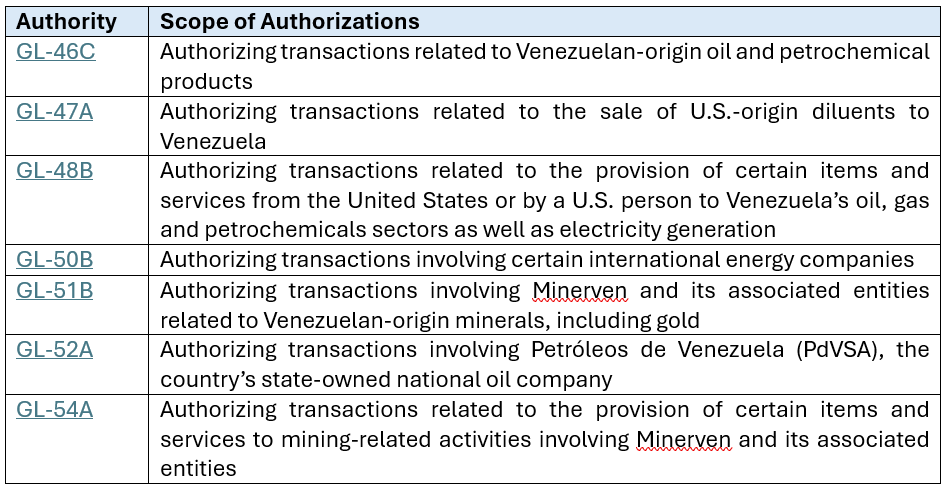
The amended GLs continue to instruct relevant parties to facilitate payments made to authorized parties that are otherwise blocked to the Foreign Government Deposit Fund or another account as instructed by the Treasury Department, pursuant to Executive Order (E.O.) 14373 (January 9, 2026).3 Payments made for local taxes, permits, or fees relating to relevant transactions with authorized Venezuelan entities need not be facilitated in this manner. Importantly, the aforementioned GLs do not authorize transacting with parties that are designated onto the List of Specially Designated Nationals and Blocked Parties (the SDN List) in connection with entities other than those included in the GLs, and businesses must take a holistic approach to prospective and current transactions to ensure compliance and address risks accordingly.
The updated GLs issued yesterday incorporate two noteworthy changes:
- OFAC has expanded the scope of permissible venues for dispute resolution to include the United Kingdom, France, and Singapore in agreements authorized by the GLs.4 Previously, dispute resolution proceedings could only occur in the United States.5 Similarly, the previous GLs required that the agreements be “governed by” the laws of a U.S. state or jurisdiction in the U.S., while the amendments require that they merely be “construed or interpreted” under the laws of such jurisdictions – enabling parties to alternative dispute resolution procedures to utilize the procedures of the respective fora, even if they are outside the United States.
- These revisions clarify that while agreements must be “Construed or interpreted” under governed by the laws of a U.S. state or jurisdiction in the U.S., this does not preclude recognition of and adherence to applicable Venezuelan law on labor, environmental compliance, administrative permits, health and safety, and other sovereign regulatory functions.6
.png)
These are addressed in detail below.
Inclusion of Non-U.S. Dispute Resolution Venues
The previous GLs specified in Paragraph (a)(1) that the laws of a U.S. state or other jurisdiction in the U.S. govern the contract and that any dispute resolution under the contract must occur in the United States.7 Although the newly issued GLs maintain that the terms of relevant agreements must be construed in accordance with the laws of a U.S. state or other jurisdiction in the U.S., they provide that dispute resolution proceedings may occur in three additional venues: the United Kingdom, France, or Singapore.8 Furthermore, OFAC FAQ 1260 provides that if the parties were to submit their dispute to arbitration, applicable procedural rules include those agreed upon by the parties, the rules of internationally recognized institutions, or the rules of the seat of arbitration.9
Significance:
- Recognizes Compliance Challenges of Multinational Companies. Providing the option for three additional dispute resolution venues outside the United States, each with leading arbitral fora, acknowledges practical compliance challenges faced by international companies and investors that these GLs are intended to enable.
- Aligns with International Standards and Practices. The modification permits increased flexibility to align such agreements to existing contractual practices in accordance with more globally established practices, accommodating the preferences of multinationals, allowing, for example, the use of arbitration at established venues such as the London Court of International Arbitration (LCIA), The International Chamber of Commerce (ICC) in Paris, or the Singapore International Arbitration Centre (SIAC). Notably, among the entities permitted by GL 50B (previously GL 50A), BP PLC, Eni S.p.A., Établissements Maurel & Prom SA, Repsol S.A., and Shell PLC are based in the United Kingdom or the European Union.
The additional three arbitration venues reflect international trends in the sector.
As detailed above and as FAQ 1260 affirms, the United Kingdom, France, and Singapore, are each home to a main global arbitration seat which collectively represent the world’s three major seats. For alternative dispute resolutions, given that many multinational energy companies are headquartered in the United Kingdom and France, these countries are preferred, reliable venues that are well known by the commercial sector. By introducing these jurisdictions, OFAC is also facilitating transactions with Venezuela by offering non-U.S. persons and Venezuelan parties more international, less-U.S.-centric alternatives that also may convey a broader sense of neutrality to businesses. Concurrently, by continuing to require U.S. jurisdiction laws to govern agreements relying on these authorizations, OFAC is ensuring that it does not greenlight activities that could contravene U.S. policy.
Clarifications on Compliance with Venezuelan Laws and Regulations
The second change in the current versions of the GLs clarifies the first part of the requirements in paragraph (a)(1): while the contracts must be construed and interpreted under the laws of a U.S. state or other jurisdiction in the U.S., the contracts can recognize compliance with applicable Venezuelan laws and regulations in certain activities such as administrative permits and licenses, concessions, labor, environmental, health and safety, and other mandatory regulatory requirements.10
Significance:
- Conveys OFAC’s recognition of the practicalities of day-to-day operations of a multinational business in-country. The change also aligns the Administration’s policy without encumbering it with limitations that do not materially benefit that policy. Allowing LCIA, ICC, or SIAC arbitration for such agreements increases the likelihood of the arrangements envisioned by the Trump Administration materializing without compromising U.S. policy objectives of keeping disputes over such contracts from being heard in less friendly jurisdictions.
- Prevents Needless Deterrence and Derisking. By clarifying the policy, OFAC has removed key ambiguity by providing pointed direction. This addresses a common shortcoming of GLs which causes parties, especially those outside the U.S., to adopt risk-averse positions far exceeding limitations imposed by law.
What Should Businesses Expect?
- Accommodation of Operational Challenges: The amended GLs reflect a pragmatic commitment by OFAC and the Treasury Department to make certain sectors of the Venezuelan economy accessible to U.S. investment and investment from certain non-U.S. companies. The current authorizations signal continuous efforts by OFAC to accommodate practical and legal challenges faced by multinationals seeking to participate in the Venezuelan economy in adherence to these licenses, while putting U.S. interests at the forefront.
- Alignment with Venezuelan Reform Efforts: This development reflects the January 2026 amendments to Venezuela’s Hydrocarbons Laws, which (1) ease the state’s control in foreign private investments, and (2) allow for independent arbitration of disputes. The amended GLs effectively serve as an acknowledgment by the United States of legislative changes by Venezuela’s government. At the same time, the updated authorizations continue enabling investments in Venezuela’s energy sectors despite complex transactional and legal compliance challenges.
- Persisting Compliance Considerations: Importantly, the current GLs only provide partial relief of U.S. sanctions targeting Venezuela. Businesses must continue conducting vigilant due diligence and seek guidance when applicable to ensure their activities remain compliant with the authorizations established by these GLs.
- Possible Emerging U.S. Sanctions Policy Trends: Yesterday’s updates address both the engagement of U.S. allies vis-à-vis Venezuela as well as operational practicalities. Such liberalizations are being implemented at a more calibrated pace compared to the near-overnight changes seen with the Syria sanctions and export controls framework following the fall of Bashar Assad’s government in 2024, accounting for the contrasting underlying political shifts and policies. Importantly, it could provide a model for OFAC in issuing future relief when unraveling or phasing out other sanctions frameworks. OFAC will likely continue incorporating market feedback on sanctions implementation and revise conditional authorizations as needed, enabling routine, inoffensive activities necessary to facilitate commercial transactions the agency views favorably.
Please contact Farhad Alavi (Washington) at falavi@akrivislaw.com or +1.202.686.4859 if you have any questions.
Special thanks to John Kallas and Kristen Xiao for their assistance in preparing this Legal Update.
This Legal Update is intended solely for informational purposes and should in no way be construed as legal advice, nor shall the information shared here result in or constitute the formation of an attorney-client relationship with anyone who reads it. If you have any questions or are unclear on any of the subject matters addressed or discussed in this Legal Update, please consult a licensed legal professional.
Citations:
[1] U.S. Dep’t. of the Treas., Off. of Foreign Assets Control, Venezuela General License No. 46C, “Authorizing Certain Activities Involving Venezuelan-Origin Oil or Petrochemical Products”; U.S. Dep’t. of the Treas., Off. of Foreign Assets Control, Venezuela General License No. 47A, “Authorizing the Sale of U.S.-Origin Diluents to Venezuela”; U.S. Dep’t. of the Treas., Off. of Foreign Assets Control, Venezuela General License No. 48B, “Authorizing the Supply of Certain Items and Services to Venezuela”; U.S. Dep’t. of the Treas., Off. of Foreign Assets Control, Venezuela General License No. 50B, “Authorizing Transactions Related to Oil or Gas Sector Operations in Venezuela of Certain Entities”; U.S. Dep’t. of the Treas., Off. of Foreign Assets Control, Venezuela General License No. 51B, “Authorizing Certain Activities Involving Venezuelan-Origin Minerals, Including Gold”; U.S. Dep’t. of the Treas., Off. of Foreign Assets Control, Venezuela General License No. 52A, “Authorizing Certain Transactions Involving Petróleos de Venezuela, S.A”; U.S. Dep’t. of the Treas., Off. of Foreign Assets Control, Venezuela General License No. 54A, “Authorizing the Supply of Certain Items and Services for Minerals Operations in Venezuela”.
[2] See, e.g., Publication of Venezuela Sanctions Regulations Web General Licenses 48A and 49A, 91 FR 35143 (June 10, 2026).
[3] Exec. Order No. 14373, 91 F.R. 2045 (2026).
[4] See, e.g., U.S. Dep’t. of the Treas., Off. of Foreign Assets Control, Venezuela General License No. 46C.
[5] See, e.g., U.S. Dep’t. of the Treas., Off. of Foreign Assets Control, Venezuela General License No. 46B.
[6] OFAC FAQ #1260: Does the requirement in certain Venezuela General Licenses (e.g., 46C, 47A, 48B, 50B, 51B, 52A, and 54A) that the terms of contracts be construed and interpreted in accordance with the laws of a state or other jurisdiction within the United States mean that U.S. law must govern all aspects of the underlying activity?, U.S. Dep’t of the Treas., Off. Of Foreign Assets Control, https://ofac.treasury.gov/faqs/1260 (updated June 10, 2026).
[7] See, e.g., U.S. Dep’t. of the Treas., Off. of Foreign Assets Control, Venezuela General License No. 46B(a)(1), “the laws of the United States or any jurisdiction within the United States govern the contract and that any dispute resolution under the contract occur in the United States."
[8] See, e.g., U.S. Dep’t. of the Treas., Off. of Foreign Assets Control, Venezuela General License No. 46C(a)(1)(ii), “dispute resolution proceedings relating to the contract occur in the United States, the United Kingdom, France, or Singapore”.
[9] U.S. Dep’t of the Treas., Off. Of Foreign Assets Control, Frequently Asked Questions No. 1260 (Jun. 10, 2026), https://ofac.treasury.gov/faqs/1260.
[10] See, e.g., U.S. Dep’t. of the Treas., Off. of Foreign Assets Control, Venezuela General License No. 46C(a) n. 4, “The requirement in paragraph (a)(1)(i) permits the inclusion of contract terms that recognize that certain aspects of the underlying activity in Venezuela may be subject to applicable Venezuelan law and regulations, including laws and regulations governing the exercise of Venezuela’s sovereign regulatory authority, administrative permits and licenses, concessions, labor, environmental, health and safety, and other mandatory regulatory requirements.”
Partner, Washington, DC
In Brief:
- On May 18, 2026, the U.S. Department of the Treasury’s Office of Foreign Assets Control (OFAC) announced a settlement with Adani Enterprises Limited (AEL) of India for $275,000,000 after finding that the company facilitated 32 U.S. dollar-denominated payments to import Iranian-origin liquid petroleum gas (LPG) into India.
- AEL, a publicly listed company, made the payments to a Dubai-based supplier purporting to sell LPG originating from Iraq and Oman, although multiple red flags in the fact pattern strongly suggested that the actual origin was Iranian.
- OFAC considered these violations egregious, based on factors including the lack of further investigation into the source of the LPG in the context of AEL’s commercial sophistication, as well as the harm these purchases caused to Iran-related sanction program’s objectives. At the same time, mitigating factors such as AEL’s cooperation with the investigation into these transactions and the small share of AEL revenue their LPG operations comprise were considered when reaching the penalty amount.
- The AEL penalty alone exceeds the total penalties levied by OFAC in 2025, which covered 14 cases, and offer yet one more signal of the Trump Administration’s accelerated policy of maximum pressure against Iran, manifested by the Treasury Department’s “Economic Fury” policy targeting Iran’s oil and gas, as well as financial sectors.
Farhad Alavi, Partner, Washington, DC
May 12, 2026
In Brief:
- OFAC has in recent weeks accelerated enforcement action against Iran’s energy sector, including oil and petrochemicals, targeting players in Iran, China, and elsewhere, part of a broader effort that has been ongoing for over a year.
- The agency has also targeted Iran’s financial sector and payment systems by designating scores of entities outside Iran onto the SDN List.
- These actions reflect the Trump Administration’s policy of maximum pressure and “economic fury” on Iran and underscore the need for smarter, more dynamic compliance by companies operating globally, particularly in key sectors and regions.
Introduction
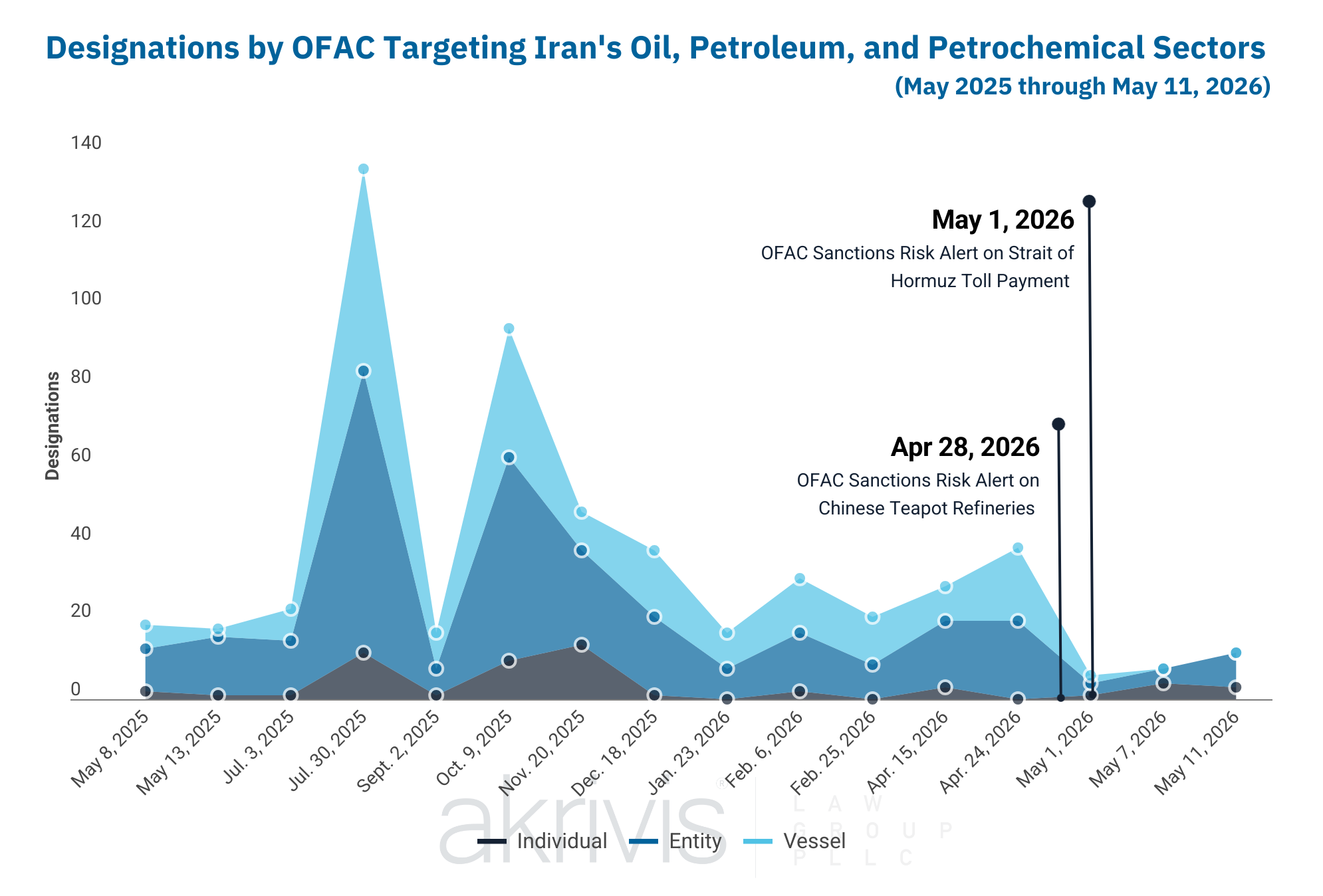
The U.S. Department of the Treasury’s Office of Foreign Assets Control (OFAC) has in recent weeks accelerated its targeting of Iran’s energy sector and related supply chains, designating a web of foreign refineries, payment facilitators, and exchange houses around the world, and clarifying its position on Iranian regime “toll” payments for safe passage in the Strait of Hormuz and dealings with Iranian digital exchanges. In addition to new rounds of designations, OFAC issued two Iran-related sanctions risk alerts – one for financial institutions, emphasizing the risks posed by independent oil refineries in China for their alleged role in transacting sanctioned Iranian crude oil,1 and a second clarifying that payments for the safe passage of vessels through the Strait of Hormuz bear sanctions risks for U.S. and non-U.S. persons regardless of payment method.2
Alongside OFAC’s actions, the Department of the Treasury’s Financial Crimes Enforcement Network (FinCEN) released an advisory yesterday reminding financial institutions of their reporting obligations under the Bank Secrecy Act (BSA) if they suspect activities related to financing for Iran’s the Islamic Revolutionary Guard Corps (IRGC). The advisory emphasizes activities related to laundering oil smuggling proceeds.3
These very recent actions underscore the Trump Administration’s expanding emphasis on targeting Iran’s oil sector and expanding sanction violations. Given the international reach of Iran’s vast web of sanctions circumvention, compliance challenges are pervasive and not limited to Iran. This effectively mandates companies in the oil and related sectors to exercise heightened vigilance.
Context
In a span of three days, OFAC issued two alerts on Iranian sanctions risks:
- April 28, 2026: Covering financial institutions of the risk in dealings with Chinese independent refineries, also known as “teapot” refineries, that could be purchasing and refining Iranian crude oil; and
- May 1, 2026: Clarifying that payments to Iran for passage through Strait of Hormuz bear sanctions risk for U.S. and non-U.S. persons.
Less than two weeks later, FinCEN issued an advisory on May 11, 2026 on reporting suspicious activities related to Iranian sanctions evasion, reminding financial institutions of the reporting requirements under the BSA on suspicious activities related to funding and facilitating the procurement networks supporting the IRGC, especially through use of front companies, facilitator networks, and digital assets. This Advisory also provided key red flags to consider in suspicious transactions.
These recent alerts underscore the Treasury Department’s commitment to maintain comprehensive sanctions on Iran and especially the country’s oil, petroleum, and petrochemical sectors. This is relevant not just for U.S. persons who are prohibited from transacting with any blocked entities, but also non-U.S. persons, which can face secondary and derivative sanctions exposure.
Targeting Iran’s oil and petrochemical sector and related shadow banking network
OFAC’s actions recent weeks, when reviewed in isolation or in the agency’s broader actions against Iran since last year, send a clear signal that Iran’s oil and petrochemical and the related shadow banking and shipment sectors are a key target as part of the broader maximum pressure campaign against the Iranian regime.
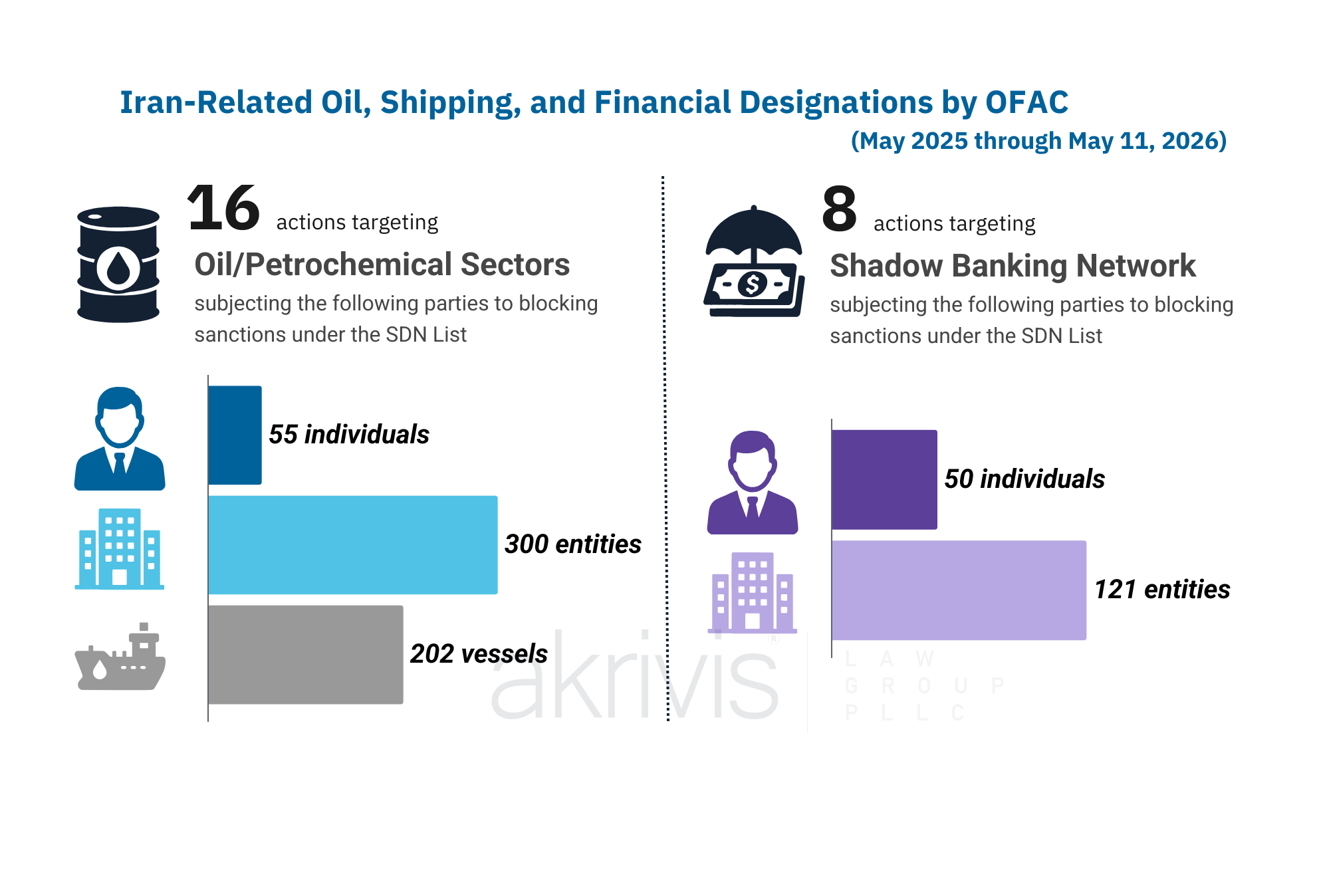
Specifically, OFAC has in the period since May 2025 taken:
- Oil and Petrochemical Sectors: 16 actions, resulting in the following additions to its List of Specially Designated Nationals and Blocked Persons (the “SDN List”):
- 55 individuals
- 300 entities
- 202 vessels
- Eight separate actions against Iran’s shadow banking networks that are often used to process oil-related payments, resulting in the following designations onto the SDN List:
- 50 individuals
- 121 entities
- Clarified via a Frequently Asked Question4 (FAQ) on its website that Iranian digital asset exchanges are considered blocked.
- Confirmed via another FAQ that sanctions prohibit payment to the Iranian regime and/or the IRGC by US persons and could expose foreign financial institutions to sanctions exposure.5
Many of these designations have been under Executive Order (EO) 13902 (January 10, 2020), a broad-based authority executed by President Trump in his first Administration allowing for the blocking of parties operating in key sectors of Iran’s economy. Other authorities include the Global Terrorism Sanctions Regulations, 31 CFR Part 594 (the “GTSR”), EO 13949 (September 21, 2020), and the Weapons of Mass Destruction Proliferators Sanctions Regulations, 31 CFR Part 544 (the “NPWMD”). OFAC has also relied on sectoral (non-blocking) authorities of the Iranian Financial Sanctions Regulations, 31 CFR Part 561 (the “IFSR”), with parties under this designation not being blocked (described below), but rather substantially limited in the scope of financial activities they can engage in with U.S. financial institutions.6
U.S. persons are generally prohibited from nearly all transactions in goods, services, and technology with parties on the SDN List, and any assets in which such parties hold an “interest,” a term OFAC defines broadly, that are in the United States or coming into the possession of a U.S. person (e.g., U.S. companies, citizens or permanent residents regardless of where in the world they are located, or any other person physically in the United States) must be blocked.
The effects can be far more pronounced as, under OFAC’s “50 percent rule,” entities owned in the aggregate 50% or more by blocked parties are themselves considered blocked and under the same restrictions as their upstream SDN owners. While all SDNs are “blocked,” not all blocked parties are SDNs. This is a key point - These entities are often not named on the SDN List, highlighting the need for increased vigilance in due diligence and compliance.
While the limitation on dealings with blocked parties are generally aimed at U.S. persons, such dealings can subject non-U.S. persons to derivative blocking, and today’s global derisking landscape in fields such as banking means blocked parties invariably face similar restrictions even outside the United States. Specifically, the designations can trigger a cascading “de-platforming” of these entities by non-U.S. businesses outside the United States, resulting in a loss in banking privileges, financial freezes, and broader limitations.
In addition to OFAC’s alerts, FinCEN’s May 11, 2026 alert on Iran’s shadow banking network, using BSA data published in October 2025,7 identified that shell companies linked to Iran moved roughly $5 billion in the global financial system in 2024.8 This supplements another FinCEN’s advisory from June 2025 on exchange houses and front companies being used to settle the proceeds from Iran’s oil and petrochemical trades.

The increased enforcement is not surprising due to the continuous evolution of sanctions evasion tactics used by parties dealing in Iran’s oil and gas and related sectors. More broadly, OFAC signaled in late March that it is looking beyond ownership and interests of blocked property to “underlying practical and economic realities” of transactions in its enforcement and designation actions.9 As a result, oil traders and financial institutions could inadvertently violate sanctions even if none of the transacting parties ostensibly have a connection to Iran and none are blocked pursuant to OFAC regulations or Executive Orders.
Examples of these less apparent sanctions violations include the “rebadging” of oil --- re-branding oil of sanctioned origin as originating from a non-sanctioned origin to bypass restrictive measures from buyers or intermediating parties. As such, a downstream transaction distanced from any blocked parties on paper and ostensibly bearing no evident reference to Iran could nonetheless run afoul of U.S. sanctions.10
The risk of sanctions violations for both U.S. and non-U.S. persons is especially salient in light of OFAC’s recent temporary authorizations for certain in-transit oil cargoes. In March 2026, OFAC temporarily eased sanctions on Iranian-origin oil through Iran-Related General License (GL) U, authorizing certain transactions involving in-transit Iranian-origin cargoes through April 19, 2026. Almost concurrently, on March 12, 2026, OFAC issued similar authorizations for in-transit Russian-origin oil GL 134, which was valid through April 11, 2026. As the origin of oil heavily can heavily impact the sanctions exposure associated with dealings in downstream products, bad-faith actors utilize alternative payment methods, front companies, or fraudulent identification to ship the sanctioned crude to teapot refineries. Notably, refining could make tracing the oil’s origin logistically more difficult, involving the use of petroleum forensics on certain isotopic footprints. By imposing pressure on the entire supply chain of Iranian oil, OFAC ensures that the chemical transformation inside a refinery cannot be abused as a legal shield to mask the sanctioned crude origin of non-sanctioned refined products.
A second key focus of the Treasury Department’s enforcement is on Iran’s multi-jurisdictional shadow banking networks, as highlighted in the recent FinCEN advisory. Given the de facto lack of formal links between Iranian banks and their foreign counterparts (e.g., by disconnecting them from SWIFT and correspondent banking relations), Iran has in recent decades increased reliance on third country exchanges and paying agents, as well as triangulated payments. While such entities are often for legitimate purposes, they can enable illicit proceeds from sanctioned oil sales to repatriate to the Iranian regime. OFAC highlighted this issue in January when targeting numerous so-called “rahbar” companies, basically overseas agents of Iranian financial institutions that handle hard currency and international trade transactions for Iran by proxy.
Shadow banking networks commonly use Iranian exchange houses to manage front and trading companies, exploiting gaps in regional bank reporting requirements, such as policies intended to ease banking friction in commercial free trade zones, to open accounts and conduct large, opaque transactions. Other networks falsify the source of funds to evade detection by regional banks with U.S. correspondent banking relationships, allowing foreign currency to be converted into U.S. dollars. These types of fraudulent and opaque structures, by design, make U.S. and non-U.S. financial institutions prone to inadvertently moved illicit funds through the global financial system.
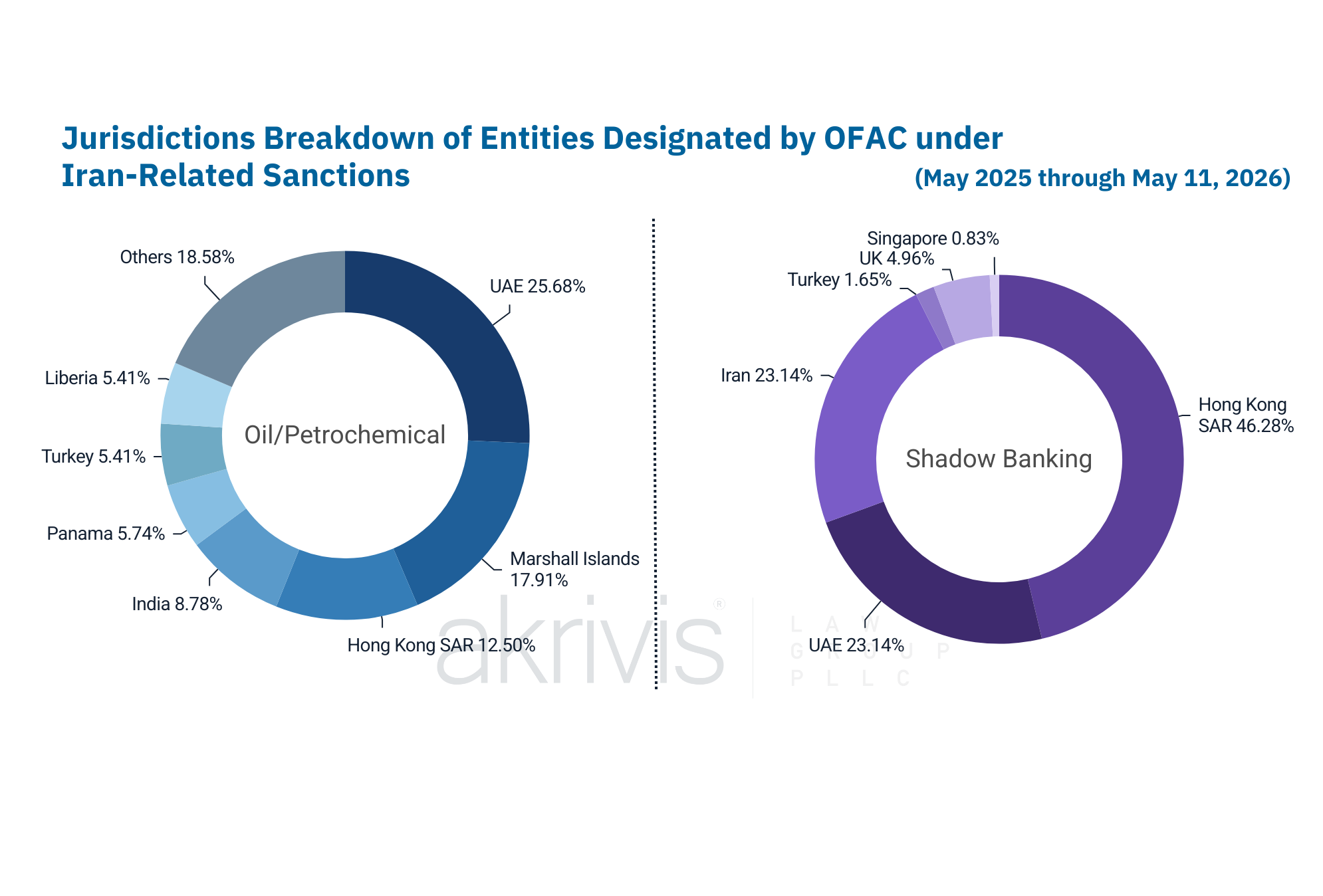
OFAC’s enforcement appears to reflect a commitment to close the banking gaps. Notably, common third-country jurisdictions for such front companies are also among the top targeted jurisdictions for shadow banking enforcement, and increasingly such countries are cooperating in a crackdown on illicit Iranian activities. Additionally, as digital wallets rise in prevalence, especially among illicit financial operators to evade detection common to a traditional banking environment, OFAC also targeted crypto-based funds facilitators in the September 16, 2025 designations, IRGC-linked digital asset exchange on January 30, 2026, and facilitators building circumvention infrastructure in other actions. In particular, OFAC listed digital currency addresses for two coordinators of crypto-based sales in its September 16, 2025 notice.11
Key Takeaways
OFAC and FinCEN’s recent actions reflect a concerted effort to target activities that provide funding for the Iranian regime and recent enforcement action should be viewed in the broader context of the current U.S.-Iran conflict and the Trump Administration’s maximum pressure campaign against Iran. Current geopolitics driving down the supply of oil and the de facto closure of the Strait of Hormuz has not only disrupted supply chains but could easily accelerate sanctions exposure risks, OFAC and FinCEN’s alerts provide a window to the private sector into the Treasury Department and more broadly, the executive branch’s sanctions enforcement priority, noting that this policy could easily lead to more criminal enforcement of violations as well both for companies, and perhaps more likely for individuals, such as corporate executives and traders.
As with most sanctions enforcement, players in the energy and logistics as well as related sectors should be cognizant of and responsive to the shifting legal and enforcement landscape and respond to the ever-evolving risks presented. While foreign companies doing business in this sphere risk blocking sanctions, civil and criminal enforcement, U.S. companies and individuals can face civil and criminal penalties for similar allegations.
Given this reality, U.S. and non-U.S. businesses and executives can, in consultation with expert counsel and compliance specialists:
- Become fully aware of key sector-specific risks and not being willfully unaware. These include:
- Evolving trends and patterns in sanctions evasion tactics, defining key red flags
- The use of intermediary and front entities in both procurement and financing
- Supply chains
- Supporting logistics infrastructure (e.g., payment systems and shipping)
- “Phantom” Iran related transactions – these can be illicit sales and payments for the benefit of Iran and/or blocked entities where no parties appear to be Iranian or connected to Iran, nor blocked
- Procurement or payment opportunities that look “too good to be true”
- Strange or atypical payment methods
- Respond to shifting risks. This is done by:
- Defining risk appetite based on knowledge of the above
- Systematically incorporating heightened and expanded counterparty due diligence, including robust “know your customer” (KYC) and “know your customer’s customer” (KYCC) approaches, with a clear strategy to obtain truthful ultimate beneficial owner (UBO) information to determine potential blocking or simply diversion and even reputational risks
- Identifying thresholds for when to rely on expanded business intelligence beyond internal “in house” capabilities, such as those offered by third party diligence providers and whether to invest in broader based diligence tools; and
- Expanding and strengthening contractual representations and warranties, covenants, and force majeure clauses in agreements to address and mitigate sanctions exposure.
- Periodically reassessing risk appetite and risk management approaches and tailoring processes based on sectoral shifts and changing geopolitical realities.
- Understanding that as the regime seeks to rebuild facilities and plants damaged from U.S. and Israeli attacks that obscure, shadowy procurement behavior and processes may emerge, and U.S. enforcement against such activities will likely accelerate on both civil and criminal fronts
The Treasury Department’s actions vis-à-vis Iran in many ways reflects the broader contours of U.S. sanctions and export control policies – ever-expanding and underscoring the need for compliance. Such compliance is becoming increasingly challenging given the increasing complexities of regulatory frameworks and the expansion of prohibited parties lists such as the SDN List. This highlights the need for relentless attentiveness, hypervigilance, and by extension, properly directing company resources to understand and meet these needs.
Please contact Farhad Alavi (Washington) at falavi@akrivislaw.com or +1.202.686.4859 if you have any questions.
Special thanks to Kristen Xiao for her help with this Legal Update.
This Legal Update is intended solely for informational purposes and should in no way be construed as legal advice, nor shall the information shared here result in or constitute the formation of an attorney-client relationship with anyone who reads it. If you have any questions or are unclear on any of the subject matters addressed or discussed in this Legal Update, please consult a licensed legal professional.
1U.S. Dep’t of the Treasury, Office of Foreign Assets Control, Sanctions Risk of Dealing with Teapot Oil Refineries (Apr. 28, 2026), https://ofac.treasury.gov/media/935546/download?inline.
2U.S. Dep’t of the Treasury, Office of Foreign Assets Control, Sanctions Risks of Iranian Demands for Strait of Hormuz Passage (May 1, 2026), https://ofac.treasury.gov/media/935556/download?inline.
3https://www.fincen.gov/system/files/2026-05/FinCEN-Alert-IRGC.pdf.
4U.S. Dep’t of the Treasury, Office of Foreign Assets Control, Frequently Asked Questions No. 1250 (May 1, 2026), https://ofac.treasury.gov/faqs/1250.
5U.S. Dep’t of the Treasury, Office of Foreign Assets Control, Frequently Asked Questions No. 1249 (Apr. 28, 2026), https://ofac.treasury.gov/faqs/1249.
631 CFR § 561.309.
7U.S. Dep’t of the Treasury, Financial Crimes Enforcement Network, Iranian Shadow Banking: Trends in Bank Secrecy Act Data (Oct. 23, 2025), https://www.fincen.gov/system/files/2025-10/FTA-Iranian-Shadow-Banking.pdf.
8U.S. Dep’t of the Treasury, Financial Crimes Enforcement Network, FinCEN Alert on the Use of Front Companies, Financial Facilitators, and Digital Asset Infrastructure by Iran’s Islamic Revolutionary Guard Corps to Evade Sanctions and Launder Proceeds (May 11, 2026), https://www.fincen.gov/system/files/2026-05/FinCEN-Alert-IRGC.pdf.
9U.S. Dep’t of the Treasury, Office of Foreign AssetsControl, Guidance on Sham Transactions and Sanctions Evasion (Mar. 31, 2026), https://ofac.treasury.gov/media/935441/download?inline.
10ld.
11U.S. Dep’t of the Treasury, Office of Foreign Assets Control, Counter Terrorism Designations (Sept. 16, 2025), https://ofac.treasury.gov/recent-actions/20250916.
WASHINGTON, D.C. – April 7, 2026 – Akrivis Law Group, PLLC is pleased to announce that on April 3, 2026, the U.S. Department of the Treasury’s Office of Foreign Assets Control (OFAC) officially removed Mikhail Zadornov from the Specially Designated Nationals and Blocked Persons (SDN) List.
In a landmark ruling, the U.S. Supreme Court rejected President Trump’s sweeping tariffs, holding that the International Emergency Economic Powers Act1 (IEEPA) does not authorize the President to impose tariffs. The Court delivered its opinion on the consolidated cases of Learning Resources, Inc. v. Trump and V.O.S. Selections v. Trump and upheld the conclusion from lower court ruling that the Presidential power to impose tariffs exceeds the authority granted by the Congress under IEEPA, a 1977 statute traditionally used as an authority for the imposition of U.S. sanctions against particular jurisdictions as well as legal and natural persons. As a result of the Supreme Court’s ruling, U.S. importers could potentially collect refunds on excess tariffs paid, with reports suggesting over $175 billion having been paid in such additional tariffs.2
Senior Counsel Valentin Povarchuk will be speaking at the ACI Global Encryption, AI, Cloud & Cyber Export Controls conference in San Francisco on March 16-17 to share his insights building export-controlled technology control plans at multinational manufacturing and technology companies. We encourage our clients and colleagues working in this area to take part.
Akrivis wishes its clients and friends a very joyous and blessed Eid / Bayram holiday marking the end of the holy month of Ramadan.
Managing Partner Farhad Alavi was interviewed and quoted in a Bloomberg article titled Did Donald Trump’s Executives Violate the Cuban Embargo? The article covers repeated travel to Cuba by affiliates of the Trump Organization where potential hotel and golf course sites were scouted on the island state, and how this can be interpreted as a violation of the United States’ longstanding embargo. Despite a recent loosening of the Cuban sanctions, most business with Cuba remains off-limits for U.S. persons, and unfettered travel without specific authorization from the U.S. Department of the Treasury’s Office of Foreign Assets Control (OFAC) is still not permitted, rather, travel must be through one of a limited number of permissible transactions.
Akrivis Law Group, PLLC is pleased to release its latest Client Alert, titled United States implements significant relaxation of Cuba Sanctions, co-written by Managing Partner Farhad R. Alavi and Senior Counsel Eric N. Ubias. This Client Alert concisely details some of the key changes to the U.S. sanctions regime in place against Cuba as implemented earlier this week.
For more information contact Farhad R. Alavi at falavi@akrivislaw.com or +1.202.686.4859 or Eric N. Ubias at eubias@akrivislaw.com or +1.202.730.1271.
The U.S. Court of Appeals for the District of Columbia Circuit ruled today in favor of our client Epsilon Electronics, Inc., in a case against the U.S. Department of the Treasury’s Office of Foreign Assets Control (OFAC), the primary U.S. government body administrating trade restrictions against sanctioned countries like Iran and Cuba. This case is already the subject of exceptional interest and significance for the trade compliance community. The ruling is particularly timely in the aftermath of the agreement over Iran’s nuclear program resulting in the 2015 Joint Comprehensive Plan of Action (JCPOA), which led to partial but not complete sanctions relief for Iran.
November 6, 2018. Akrivis Law Group, PLLC is pleased to issue its latest Client Alert, titled U.S. Completes Reintroduction of Post-JCPOA Iran Sanctions. The United States completed its phase-in of sanctions against Iran following the decision by President Donald Trump to withdraw from the Joint Comprehensive Plan of Action (JCPOA, commonly referred to as the Iran nuclear deal), which has been entered into by Iran and the “P5+1” states (the United States, United Kingdom, France, Russia, China, and Germany) in 2015 and implemented in 2016. These are mainly sanctions that had been lifted and/or relaxed as a result of that agreement.
On October 18, 2017, Akrivis Law Group, PLLC with the help of its friends at AmCham Abu Dhabi, held a compliance briefing at the Ritz-Carlton Dubai International Financial Center (DIFC). Managing Partner Farhad Alavi presented on the latest developments in the U.S. sanctions framework and answered questions.
Akrivis Law Group, PLLC co-hosted a trade compliance seminar in Copenhagen, Denmark on April 8, 2019 with Gorrissen Federspiel, one of Scandinavia’s leading law firms. This workshop, held at the Danish firm’s Copenhagen headquarters, was led jointly by Farhad Alavi, Partner, and Camilla Collett, Partner, and Ida Krogh-Otzen, Assistant Attorney, Gorrissen Federspiel. The discussion focused on U.S. and E.U. sanctions, export controls, and related issues, both from a compliance and enforcement angle.
July 24, 2019. The U.S. Department of the Treasury’s Office of Foreign Assets Control (OFAC) yesterday issued an advisory on matters pertaining to Iran’s civil aviation sector. Our Client Alert can be read and downloaded here.
We are proud to announce that we secured the removal of Akrivis Law Group, PLLC client Technology Links Pvt. Ltd. from the U.S. Department of Commerce’s Bureau of Industry & Security (BIS) Entity List.
Akrivis Law Group, PLLC and AZHA Avocats of Switzerland co-hosted a sanctions compliance seminar in Geneva at the Hotel President Wilson on Thursday, January 16, 2020. The event was headlined by Akrivis partner Farhad Alavi and AZHA partner Mercedeh Azeredo da Silveira. Other speakers from the United Kingdom and France also presented. The event was attended by roughly 60 people from throughout Europe.
On July 1, the U.S. Departments of State, the Treasury, Commerce, and Homeland Security issued a detailed advisory (the “Advisory”). This is in response to the various types of regulatory exposure companies could face when dealing with suppliers and vendors in China’s northwestern Xinjiang region, given substantial allegations of forced labor and other human rights abuses there.
The U.S. Department of the Treasury’s Office of Foreign Assets Control (OFAC) announced on October 20 that it was imposing a $4.1 million penalty against Omaha, Nebraska-based Berkshire Hathaway Inc., its subsidiary MC International Metalworking Companies B.V. (“IMC”) and IMC’s wholly owned Turkish subsidiary, Iscar Kesici Takim Ticareti ve Imalati Limited Sirket (“Iscar Turkey”) for illicit transactions by Iscar Turkey with Iran. Iscar Turkey is in the business of manufacturing machinery, specifically cutting tools and inserts. The violations took place between 2012 and 2016, with Iscar Turkey entering into 144 transactions with Iran over that period. While announcements of OFAC penalties for sanctions violations are not rare, this one has a few notable points.
WorldECR (Export Control Review), a premier trade publication based in London, last month published an article co-authored by Akrivis Law Group, PLLC Partner Farhad Alavi and Daisuke Takahashi of Shinwa Sohgoh Law Offices in Japan on removal from the U.S. Department of Commerce’s Bureau of Industry & Security (BIS) Entity List and Japan’s Ministry of Economy, Trade, and Investment (METI) End-User List.
The U.S. Department of the Treasury’s Office of Foreign Assets Control (OFAC) has issued two penalties against non-U.S. financial institutions this past week. The agency’s December 28, 2020 settlement with Saudi Arabia-based National Commercial Bank (NCB) and its January 4, 2021 settlement with France-based Union de Banques Arabes et Françaises (UBAF) arguably demonstrate a more detailed evaluation by OFAC of compliance procedures and activities of foreign financial institutions processing U.S. dollar (USD) payments. Additionally, they may potentially signal more enforcement actions against foreign financial institutions going forward.
Akrivis Law Group Partner Farhad Alavi will be on a May 25 webinar panel sponsored by the American Chamber of Commerce Abu Dhabi (AmCham Abu Dhabi) including former US Ambassador to the UAE Michael Corbin, as well as other distinguished guests. Titled “Trade Expectations in the Biden Era: Policy, Diplomacy and Export Controls,” the four member panel will discuss important trade issues in the new administration, with emphasis on how they impact the UAE, US-UAE trade, and the broader region. The panel will be moderated by Charles Laubach, secretary of AmCham Abu Dhabi and a partner at Afridi & Angell in Dubai.
The U.S. Department of Commerce’s Bureau of Industry & Security yesterday added 34 entities (43 entries in total) to its Entity List, placing those parties under a near blanket ban on U.S. origin goods and technologies.
Our Client Alert, which summarizes the decision and provides insights into its significance, can be downloaded by clicking on the image below or clicking here.
As a potential invasion of Ukraine by Russia appears increasingly likely, many are speculating about the potential for U.S. sanctions. Our Client Alert, written by Akrivis Law Group partners Farhad Alavi (Washington) and Sam Amir Toossi (New York), provides some key insights as to what these trade restrictions may look like and how U.S. and non-U.S. companies can prepare accordingly. Download the PDF here.
Akrivis Partners Farhad Alavi (Washington) and Sam Amir Toossi (New York) led a Continuing Legal Education (CLE) webinar hosted by the Practising Law Institute (PLI) on Russia sanctions issue, an ever important area in the international trade compliance field. The one-hour webinar, titled Overview of Russian Economic Sanctions – Past and Present, focuses on the ramp up of Russian sanctions, key new changes, and how companies can focus and sharpen their compliance approaches and wind-down strategies.
The U.S. Departments of the Treasury and State and the Federal Bureau of Investigations (FBI) yesterday issued a joint advisory (the “Advisory”) on North Korean information technology (IT) workers informing the business community of the sanctions risks associated with recruiting and hiring individuals such as freelance developers and alerting the public to deceptive practices by such persons. The interagency guidance explains how the North Korean IT workers operate, identifies indicators that raise red flags, and suggests mitigation measures, such as due diligence to help employers from unwittingly hiring them.
Sam Amir Toossi, Partner, New York
Following Russia’s invasion of Ukraine, the United States quickly imposed sweeping sanctions on Russian entities and individuals, which the Biden Administration immediately began to take steps to aggressively enforce. The Department of Justice (DOJ) announced the formation of the KleptoCapture Task Force, an interagency law enforcement effort to enforce the sanctions and restrictions designed to punish Russia’s actions in Ukraine.
The U.S. Departments of State, Treasury, Commerce, and Labor on May 23 issued an advisory for US businesses operating in Sudan, highlighting the growing risk to US businesses and individuals associated with conducting business with Sudanese State-Owned Enterprises (SOE), which are entirely controlled by Sudan’s military following its seizure of power on October 25, 2021.
On October 21, the U.S. Department of Commerce’s Bureau of Industry and Security (BIS) added 26 companies and individuals to the Entity List for engaging in activities contrary to U.S. national security and foreign policy. The entities added were from the following jurisdictions: China (6), Egypt (1), Pakistan (16), and the United Arab Emirates (UAE) (3). These additions were made under various rationale, including alleged violations of export controls, evasions of U.S. sanctions on Russia and Iran, and involvement in weapons programs of concern. The move follows a recent trend of significant increases in Entity List additions. Nine of the Pakistani entities named to the Entity List this week were added for being associated with a previously identified company already on the Entity List, while the remaining seven were added for contributions to Pakistan’s ballistic missile program. The three UAE entities as well as the one Egyptian entity were added for acquiring U.S.-origin parts to evade U.S. Sanctions imposed on Russia. The six Chinese entities were added for acquiring U.S.-origin items in support of their military modernization, dilatory and evasive conduct during end-use checks, and procurement of U.S.-origin items for Iran’s weapons of mass destruction program.
In its latest move to counter the national security threat posed by Russia sanctions evaders, the Biden Administration targeted over 300 companies and individuals around the world on Wednesday, October 30, placing them under either sanctions or export controls lists.
The U.S. Department of the Treasury’s Office of Foreign Assets Control (OFAC) on May 23 issued a general license (GL-25) effectively lifting most prohibitions on U.S. persons on that country. This move follows President Trump’s meeting with Syrian President Ahmad Al-Sharaa earlier in the month, which in turn follows the fall of the Assad government in December 2024.
Akrivis Law Group PLLC is pleased to announce that the firm and our Florida-based partner Walter Norkin have been ranked in Chambers in the field of Litigation: White Collar Crime & Government Investigations.
Farhad Alavi (Washington Partner), Sam Amir Toossi (New York Partner), and Valentin Povarchuk (Washington Counsel) will be attending the 2025 International Bar Association (IBA) Annual Conference in Toronto this year, which will be held between November 2-7.
The U.S. Department of Commerce’s Bureau of Industry & Security (BIS) on September 29, 2025 took a significant yet anticipated step by adopting an Interim Final Rule, referred to as the Affiliates Rule, extending the restrictions imposed on entities listed on the Entity List (“EL”) to unlisted entities that are 50% or more owned by one or more of the listed entities. Presently, naming to the Entity List, the BIS’s strictest listing of non-U.S. parties, was limited to the named entity and none of its legally distinct affiliates or subsidiaries. This rule drastically changes that by capturing a wider range of related entities whose names would not necessarily be on the list. This action will have a momentous impact on many companies in China and elsewhere, significantly increasing compliance burdens, particularly on companies doing business in or with sensitive regions.